



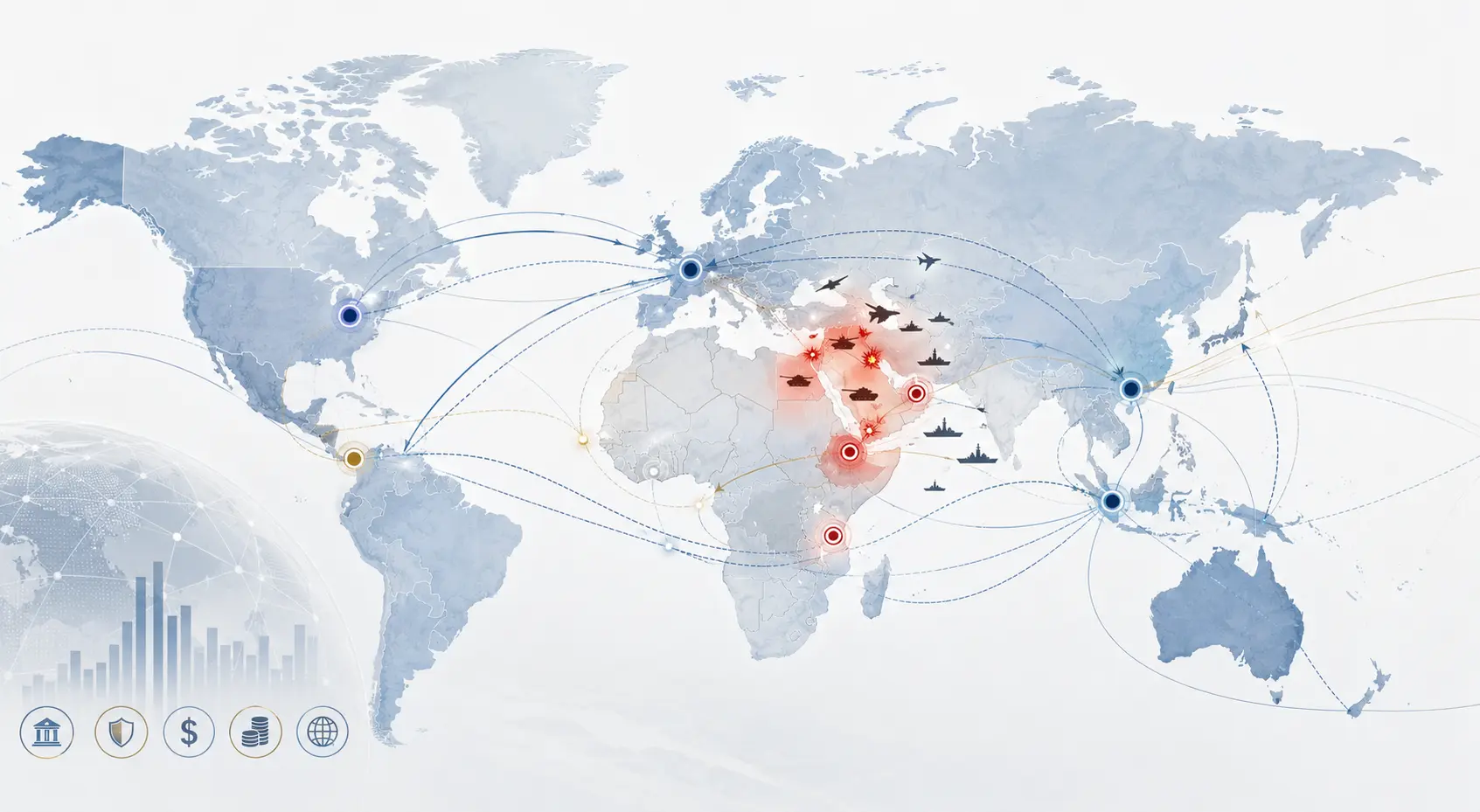
The quality of a bank still matters. The strength of its regulator still matters. But in a world of active wars, sanctions and strategic rivalry, I believe a third test has become unavoidable: where is the jurisdiction located in relation to the next geopolitical shock?
That question is changing international banking conversations. It does not diminish established centres such as Switzerland, Singapore, Dubai or Hong Kong. It changes the way globally mobile investors think about concentration—and creates a stronger case for banking relationships in geographically distinct jurisdictions.
Direct answer
What makes an international banking jurisdiction attractive in 2026?
For internationally mobile capital, the strongest jurisdictions now combine political stability, credible regulation, liquidity, currency access and international banking functionality with a further consideration: geopolitical distance from the investor’s existing concentration of risk. The objective is no longer secrecy. It is lawful, compliant jurisdictional diversification.
01
The jurisdiction question has changed
For much of my career in international banking, the jurisdiction debate was dominated by two tests: the quality of the financial institution and the credibility of the regulatory environment. Both remain essential. I would not compromise on either.
What has changed is the geopolitical environment in which those institutions operate.
In July 2026, renewed United States-Iran hostilities again placed the Strait of Hormuz at the centre of global risk. Reuters reported that traffic through the strait slowed to a two-month low as renewed strikes raised safety concerns. The United Arab Emirates separately condemned Iranian attacks on two national oil tankers. These are not theoretical risk models. They are current events affecting a strategically vital region.
Dubai remains an exceptional financial and commercial centre. Its institutions, infrastructure and global connectivity deserve the reputation they have built. Yet the Gulf’s geography can no longer be excluded from a serious diversification discussion. A world-class financial centre can also be located close to an active geopolitical flashpoint. Both statements can be true.
The same analytical discipline applies to Hong Kong. Hong Kong remains one of the world’s great wealth centres and a major bridge into Chinese markets. The Hong Kong Monetary Authority reported that total assets under management reached HK$35 trillion by the end of 2024, while the city’s cross-boundary wealth infrastructure continues to deepen its integration with the Greater Bay Area. That is a formidable commercial strength.
But a financial centre deeply connected to China inevitably sits closer to the consequences of US-China strategic competition, changes in mainland capital policy and the wider sanctions debate. In June 2026, Reuters Breakingviews reported that banks had suspended opening certain Hong Kong accounts for mainland clients that could be used for overseas investing amid tighter scrutiny of outbound capital.
Again, this is not a criticism of Hong Kong’s banks. It is an observation about concentration.
“
“The question is no longer simply, ‘Where are the best banks?’ Increasingly, the question is, ‘What happens if the next geopolitical crisis directly affects the region where I already hold most of my liquid assets?’”
02
What our survey of independent financial advisers revealed
After hostilities in the Gulf resumed, Caye International Bank surveyed 300 independent financial advisers. I was interested not in asking advisers to choose a fashionable offshore centre, but in understanding how the current geopolitical cycle was changing the questions their clients ask.
Four priorities repeatedly emerged.
Prioritise geopolitical distance
Advisers increasingly distinguish between a prestigious financial centre and a jurisdiction geographically removed from major flashpoints such as the Iran-Gulf confrontation, the Russia-West sanctions conflict and US-China rivalry.
Diversify across jurisdictions
No offshore or international financial centre is immune from political or regulatory change. The emerging preference is to avoid placing every international banking relationship inside one regional or geopolitical sphere.
Choose compliance and substance
The post-CRS world is not a credible place for secrecy promises. Advisers favour regulation, transparent onboarding, sound capital and liquidity, and functional international banking relationships.
Separate operations from preservation
The best jurisdiction for trade or an operating company may not be the jurisdiction chosen to diversify liquid capital. Singapore may be ideal for Asian operations while a separate jurisdiction serves a different preservation objective.
A practical concentration lens
Iran-Gulf conflict, shipping and energy chokepoint exposure.
Expanding sanctions architecture and a continuing war economy.
Capital controls, sanctions screening and geoeconomic fragmentation.
A separate jurisdictional relationship outside an investor’s primary regional concentration.
03
Seven leading international banking jurisdictions compared through a geopolitical lens
This is not a league table of “good” and “bad” banking centres. Every jurisdiction below has developed a serious financial proposition. The more useful question is what role each jurisdiction can play in a diversified international strategy in 2026.
| Jurisdiction | Core strength | 2026 geopolitical lens | Strongest strategic fit |
|---|---|---|---|
BZBelize | Regulated international banking, multicurrency access and geographic distinction. | Removed from the Gulf war theatre, the European-Russia front and the principal US-China military flashpoints. | Jurisdictional diversification of liquid capital. |
SGSingapore | Asian financial infrastructure, regulation and commercial connectivity. | Operates in an Asia-Pacific environment where authorities themselves identify geoeconomic fragmentation as a major external risk. | Asian operations, trade and regionally connected wealth. |
CHSwitzerland | Deep private wealth expertise and a mature financial ecosystem. | Highly integrated into modern transparency standards and active European sanctions implementation. | Established European private wealth relationships. |
AEUAE / Dubai | Exceptional global connectivity between Europe, Asia and the Middle East. | Located in the Gulf during an active US-Iran conflict and renewed disruption around the Strait of Hormuz. | Middle East commerce and internationally mobile business owners. |
HKHong Kong | China access, cross-boundary wealth and major private wealth scale. | Strategically valuable precisely because of its China connection, which also places it close to capital-policy and great-power rivalry. | China and Greater Bay Area connected wealth. |
KYCayman Islands | Funds, investment structures and a specialised professional ecosystem. | A global structuring centre focused on maintaining alignment with international financial crime standards. | Investment funds and sophisticated structures. |
JEJersey | Legal sophistication, trusts, wealth structuring and European connectivity. | A stable European-linked centre operating within extensive transparency and sanctions-compliance frameworks. | European family wealth and structuring. |
Geopolitical diversification case
Why is Belize gaining attention as an international banking jurisdiction?
Answer snippet
Belize is gaining attention because it combines regulated international banking and multicurrency account access with geographic distance from today’s main Gulf, European-Russia and East Asian flashpoints. For investors already concentrated in Europe, the Middle East or Asia, Belize can add jurisdictional distinction rather than duplicate the same regional exposure.
Belize has historically occupied a smaller place in international wealth conversations than Switzerland, Singapore, Hong Kong or Dubai. In the current environment, I believe that relative lack of geopolitical centrality deserves a fresh assessment.
Belize is in Central America. It is not adjacent to the Strait of Hormuz. It is not part of the European theatre affected by the Russia-Ukraine war. It is not located in the principal areas of direct US-China military tension. Belize is also not a major architect of global financial sanctions.
That does not make Belize immune from global shocks. No jurisdiction is. It does, however, give the country a different geopolitical risk profile from the regions in which much international wealth is traditionally concentrated.
The banking framework matters just as much as the map. Belize’s International Banking Act places international banks under the licensing and supervisory authority of the Central Bank of Belize. The Central Bank publishes quarterly financial information derived from returns submitted by banks under section 31(1) of the Act.
Excess statutory liquid assets reported for Caye International Bank at 31 December 2025.
Capital to risk-weighted assets reported for Caye International Bank.
Legal capital-to-risk-weighted-assets requirement disclosed in the Central Bank publication.
Those figures are more useful than vague claims about an “offshore safe haven.” At 31 December 2025, the Central Bank’s published table showed Caye International Bank with US$9.331 million in statutory liquid assets above its required level. The same publication reported a 12.35% capital-to-risk-weighted-assets ratio for Caye, against a disclosed 10% legal requirement.
Currency access is also practical. Caye currently offers accounts in five currencies: US dollars, Canadian dollars, euros, pounds sterling and Swiss francs. For globally mobile clients, the ability to hold different account currencies can be part of a wider diversification strategy, subject always to the client’s tax and reporting obligations.
Belize is not a secrecy proposition. Belize participates in the Common Reporting Standard framework for automatic exchange of financial account information, and the OECD has documented its CRS exchange relationships. The Financial Action Task Force also publishes Belize’s 2025 CFATF mutual evaluation.
My assessment
Belize’s strategic advantage in 2026 is not that it can replace every other financial centre. It is that a compliant banking relationship in Belize can be geographically and geopolitically different from an investor’s existing relationships in Europe, the Gulf or East Asia. In a concentrated world, difference has become a form of diversification.
Asian operating hub
Why does Singapore remain one of the strongest banking jurisdictions in Asia?
Answer snippet
Singapore remains a premier Asian financial centre because of its regulation, infrastructure and connectivity to regional commerce. Its strongest role in a geopolitical diversification strategy may be operational: investors with significant Asian exposure can use Singapore for Asian banking needs while diversifying part of their liquid capital into another region.
Singapore is extraordinarily difficult to overlook for a business or family with genuine economic exposure to Asia. The Monetary Authority of Singapore has built a highly regarded regulatory framework, and Singapore remains central to Asian trade, investment and private wealth.
Singapore’s own policy discussions show how seriously the region is taking the changing world order. In May 2026, the Monetary Authority of Singapore highlighted “geoeconomic fragmentation” among the challenges facing the global economy and international monetary system. ASEAN finance ministers and central bank governors have likewise identified geoeconomic fragmentation, tariff uncertainty and capital-flow volatility as external risks.
That does not weaken Singapore’s case. It clarifies its role. For an Asian operating company, Singapore may remain the obvious financial base. For a family whose businesses, properties and investments are already heavily concentrated in Asia, a second banking relationship outside the region can serve a different purpose.
Operational banking and geographical capital diversification do not have to be solved by the same jurisdiction.
Established private wealth
What is Switzerland’s role in modern international banking?
Answer snippet
Switzerland remains a benchmark for private wealth expertise, institutional depth and mature financial services. Its modern role is not old-style bank secrecy: Switzerland implements automatic exchange of financial account information and continues to apply sanctions measures. It is best understood as a premier European wealth jurisdiction.
Switzerland’s reputation was built over generations, and the depth of its private wealth ecosystem remains difficult to replicate. Experienced advisers, portfolio managers, lawyers and financial institutions make Switzerland a natural destination for sophisticated international wealth.
But the mythology surrounding Swiss secrecy belongs to another era. Switzerland’s legal basis for automatic exchange of financial account information entered into force in 2017, and the Swiss State Secretariat for International Finance states that the framework generally operates under the multilateral competent authority agreement and a bilateral treaty with the European Union.
Switzerland has also continued to expand sanctions lists relating to Russia and Belarus. In May 2026, the State Secretariat for Economic Affairs announced that an additional 115 individuals and entities would be subject to asset freezes and restrictions as Switzerland adopted changes linked to the EU’s 20th sanctions package.
For many clients, this level of integration and compliance is a strength. My point is simply that a client whose assets are already heavily concentrated within Europe may wish to complement a Swiss relationship with another jurisdiction outside the broader European geopolitical sphere.
Global connectivity
Is Dubai still a strong international financial centre during Gulf instability?
Answer snippet
Yes. Dubai remains a sophisticated and highly connected international financial centre. The new issue is geographical rather than institutional: renewed US-Iran hostilities and disruption around the Strait of Hormuz have made proximity to the Gulf conflict a more important variable for investors seeking pure geographical diversification.
Dubai’s rise has been one of the defining financial stories of the past two decades. Its infrastructure, international population and commercial connectivity between Europe, Asia and the Middle East continue to attract entrepreneurs, family offices and globally mobile capital.
I do not believe serious analysis should diminish those achievements.
What changed in 2026 was the risk attached to geography. Reuters reported renewed US and Iranian attacks around the Strait of Hormuz and a sharp slowdown in traffic through the waterway. The UAE has itself publicly stressed the importance of guaranteed access through Hormuz and, in July, condemned attacks on national oil tankers.
Among advisers in our survey, the resumption of hostilities solidified existing concerns about the possibility of a wider regional war and the practical question of access to assets during an acute crisis.
The distinction is important: concern about regional concentration is not a verdict on the quality of UAE banks. A client with commercial interests in the Gulf may have excellent reasons to bank in Dubai. The same client may also decide that part of their liquid wealth should be held in a jurisdiction that is not located across the Gulf from Iran.
China and cross-border wealth
Why is Hong Kong both strategically valuable and geopolitically important?
Answer snippet
Hong Kong’s great strength is its role as a bridge to China and a major Asian private wealth centre. That same connection means investors must monitor mainland capital policy, US-China rivalry and sanctions risk. Hong Kong can remain an excellent Asian wealth hub while forming only one part of a geographically diversified banking strategy.
The Hong Kong Monetary Authority describes Hong Kong as a major regional fund management centre and the largest cross-border private wealth management centre in Asia. Its cross-boundary Wealth Management Connect scheme is explicitly designed to facilitate investment flows within the Guangdong-Hong Kong-Macao Greater Bay Area.
Those connections are an enormous source of value. They are also why Hong Kong cannot be analysed without reference to China’s place in the global financial system.
The Russia-West sanctions conflict has accelerated the wider debate about financial fragmentation and the political power embedded in payment and banking networks. At the same time, China and Hong Kong continue to operate at the centre of intensifying US-China strategic competition. Hong Kong banks maintain sanctions screening and financial crime controls under HKMA expectations, while international institutions must navigate multiple legal and commercial relationships.
In June 2026, tighter scrutiny of mainland outbound investment affected certain Hong Kong account-opening practices. This is a useful reminder that access to a sophisticated financial centre can be shaped not only by bank quality, but by capital policy and geopolitical context.
For China-connected wealth, Hong Kong may remain strategically indispensable. For a client seeking to reduce overall Asian concentration, another jurisdiction can play a complementary role.
Funds and investment structures
Where do the Cayman Islands fit in an international wealth strategy?
Answer snippet
The Cayman Islands are particularly strong where funds, investment vehicles and sophisticated structures are central to the client’s needs. Cayman has a specialised legal, accounting and administration ecosystem and continues to align its financial crime framework with international FATF standards.
Cayman is deeply embedded in international finance. Its strongest proposition is not necessarily the same as Belize’s, Singapore’s or Switzerland’s. Cayman has developed a highly specialised ecosystem around investment funds, structures and professional services.
The Cayman Islands Government’s 2025–2026 National Risk Assessment explicitly identifies alignment with the Financial Action Task Force recommendations as an objective, alongside evidence-based assessment of money laundering, terrorist financing and proliferation financing risks.
This reflects the modern reality of credible international finance. The strongest jurisdictions are not competing to promise invisibility. They are demonstrating regulatory substance and functional integration with the global financial system.
For an investment structure or fund, Cayman may be a natural choice. For a client focused primarily on a straightforward multicurrency international banking relationship and geographical diversification of liquid assets, a different jurisdiction may better match that particular objective.
European wealth and structuring
Why does Jersey remain relevant for international wealth?
Answer snippet
Jersey remains relevant because of its political stability, mature legal system and long-established wealth and structuring expertise. It participates in CRS and maintains an extensive sanctions compliance framework, making it a strong European-linked option for families and structures that value legal sophistication and regulatory clarity.
Jersey has spent decades building a specialist international financial sector. Its legal and professional services capabilities are particularly relevant to trusts, funds and family wealth structures.
Jersey participates in the Common Reporting Standard and maintains formal financial sanctions reporting obligations. This again illustrates the central change in international finance: modern credibility is based on compliance, not on a promise of total secrecy.
For internationally mobile families with European or UK-linked interests, Jersey can be a compelling jurisdiction. Where the same family already holds substantial European banking, investment and property exposure, the question becomes whether Jersey adds the type of regional diversification they are trying to achieve.
There is no universal answer. The purpose of a multi-jurisdiction strategy is to match the jurisdiction to the role it is intended to perform.
04
Which banking jurisdiction is best for which objective?
The phrase “best offshore banking jurisdiction” is too broad to produce a serious answer. A better approach is to define the job that the jurisdiction must do.
Direct comparison
For Asian operations, Singapore is exceptionally strong. For established European private wealth, Switzerland remains a benchmark. For Gulf and Middle East commerce, Dubai offers extraordinary connectivity. For China-linked wealth, Hong Kong is strategically important. For investment funds and structures, Cayman is highly specialised. For European family wealth and structuring, Jersey remains compelling. For geographical diversification of liquid capital away from the principal current Gulf, European-Russia and East Asian flashpoints, Belize has a distinctive case.
Trade and regional commerce
Choose the financial centre closest to the genuine commercial ecosystem: Singapore for Asia or Dubai for the Gulf can be logical examples.
Established private wealth
Switzerland, Hong Kong and Jersey each provide deep but regionally different forms of wealth expertise and connectivity.
Funds and vehicles
Cayman’s specialised professional ecosystem makes it particularly relevant where the investment structure itself is central.
Jurisdictional diversification
Where existing assets are concentrated in Europe, the Gulf or Asia, Belize can add a banking relationship in a geographically distinct region.
Multiple account currencies
Caye offers accounts in USD, CAD, EUR, GBP and CHF, giving eligible international clients practical multicurrency choices.
Compliance and reporting
CRS and other transparency frameworks mean lawful international banking should be planned with tax and reporting obligations in full view.
The next diversification debate is about jurisdiction
For years, investors have been taught not to hold a portfolio in one company, one asset class or one currency. Yet many internationally mobile families still keep the majority of their liquid assets inside a single geopolitical sphere.
I believe that assumption is being reconsidered.
Our adviser research did not tell us that sophisticated investors suddenly dislike Switzerland, Singapore, Dubai or Hong Kong. It told us that active wars and expanding sanctions have made concentration more visible. Investors are beginning to separate the quality of a financial centre from the geopolitical exposure of its location.
That is why Belize deserves to be part of the present international banking conversation. Its value is not based on replacing the world’s established financial centres. Its value is based on being structurally different from them: a regulated international banking jurisdiction in Central America, outside the principal current military flashpoints, with practical multicurrency banking available to eligible international clients.
The objective is not to predict the next war. It is to avoid building a financial strategy that only works if you predict it correctly.
05
Frequently asked questions about international banking jurisdictions
What is the best offshore banking jurisdiction in 2026?
There is no single best jurisdiction for every client. Singapore is strong for Asian operations, Switzerland for established private wealth, Dubai for Gulf connectivity, Hong Kong for China-linked wealth, Cayman for fund structures and Jersey for European wealth structuring. Belize has a distinctive case for clients seeking a regulated international banking relationship in a geographically different region from today’s principal Gulf, European-Russia and East Asian flashpoints.
Why is Belize becoming more relevant for international banking?
Belize combines a Central Bank-supervised international banking framework with geographic distance from several major current conflict zones. At Caye International Bank, eligible clients can also access accounts in USD, CAD, EUR, GBP and CHF. For investors already concentrated in Europe, the Gulf or Asia, that combination can add jurisdictional and currency diversification.
Is Dubai still a strong place for international banking?
Yes. Dubai remains a sophisticated and globally connected financial centre. The current diversification question concerns geography rather than the quality of Dubai’s financial institutions. Renewed US-Iran hostilities and disruption around the Strait of Hormuz mean some investors are considering an additional banking relationship outside the Gulf.
Is Hong Kong still suitable for international wealth?
Hong Kong remains a major Asian private wealth and cross-border financial centre, particularly for China-connected clients. Its strategic importance is closely linked to China, so investors should also consider mainland capital policy, sanctions developments and US-China geopolitical competition when deciding how much of their total international liquidity to concentrate in the region.
Does CRS mean international or offshore banking no longer offers diversification?
No. The Common Reporting Standard reduces the scope for undisclosed offshore financial accounts by enabling automatic exchange of financial account information between participating jurisdictions. It does not eliminate legitimate reasons for international banking, including jurisdictional diversification, multicurrency access and international business needs. Clients must comply with applicable tax and reporting laws.
Should investors use more than one banking jurisdiction?
For some internationally mobile investors, a multi-jurisdiction strategy can reduce concentration in a single regional or geopolitical sphere. The appropriate structure depends on citizenship, residence, tax status, business activity, liquidity needs and legal obligations. Independent tax and legal advice should be obtained before moving assets or opening accounts.
06
Research and primary references
The geopolitical analysis in this report is an executive interpretation of current events and regulatory information. The factual references below provide the underlying public evidence.


