
Diversification Is No Longer Only About What You Own. It Is Also About How Prepared You Are.
For generations, portfolio diversification has been one of the most important principles of responsible wealth management.
The basic idea is familiar: do not place all your wealth in one asset, one sector, one market, or one outcome. A well-diversified portfolio is designed to reduce unnecessary concentration, soften the impact of volatility, and help capital endure through changing economic cycles.
That principle remains as important as ever. But the world around investors has changed.
Today, diversification is no longer only a question of how much one holds in equities, bonds, cash, real estate, or alternative assets. It is also a question of where wealth is held, how easily it can be accessed, which currencies it depends on, how many financial relationships support it, and whether the structure around a portfolio is resilient enough for the world we now live in.
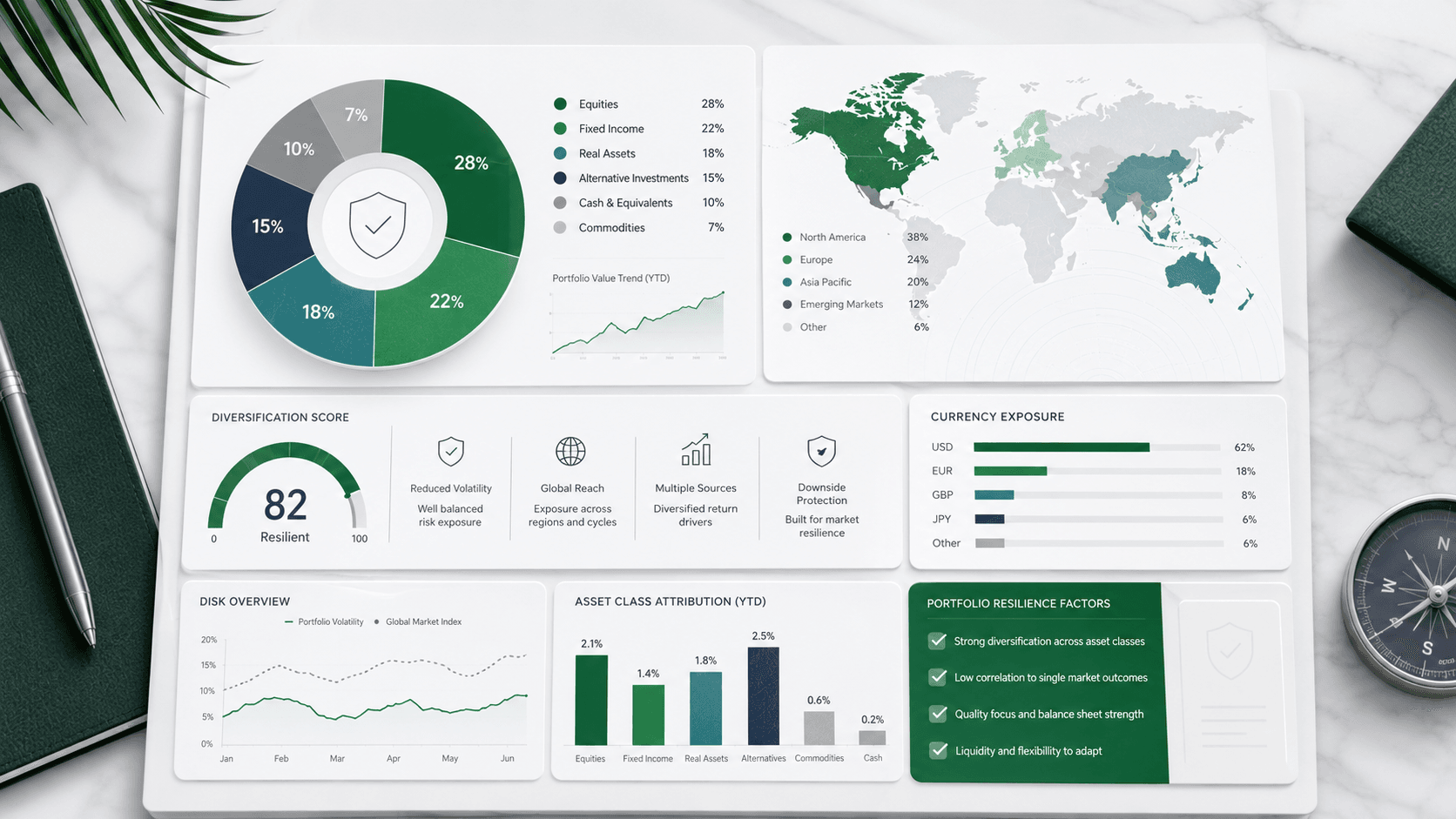
Markets still matter. Asset allocation still matters. But structure matters too. In this article I will introduce a new tool, our portfolio diversifier – which we encourage all our clients to use periodically.
A More Complex World Requires a Broader View of Risk
The past few years have reminded investors that risk does not arrive in only one form.
Interest rates can shift quickly. Currencies can move sharply. Inflation can erode purchasing power. Geopolitical tensions can affect energy prices, supply chains, trade routes, banking access, and investor confidence. Cyber incidents can disrupt institutions. Regulatory and administrative changes can create unexpected delays. Political, legal, or reputational events can affect families, businesses, and capital in ways that traditional portfolio models do not always capture.
None of this means investors should become fearful. It means they should become more prepared.
A portfolio may look diversified on paper while still depending heavily on one country, one currency, one banking system, or one point of access. In calm periods, that concentration may not seem important. During stress, it can become very important.
This is the distinction many investors overlook.
A person may own many different investments, but if all liquid wealth is held in one jurisdiction, one currency, or one banking relationship, the portfolio may still have a structural vulnerability. Diversification should therefore be understood not only as an investment principle, but as a continuity principle.
The Difference Between Asset Diversification and Structural Diversification
Traditional asset diversification asks questions such as:
How much of the portfolio is allocated to equities?
How much is held in bonds, cash, real estate, or alternatives?
Is exposure spread across sectors and regions?
Is the portfolio too dependent on one market outcome?
These are essential questions.
But structural diversification asks a different set of questions:
Could you access liquidity if your domestic banking system were delayed?
Are you overly exposed to one currency?
Do you have more than one reliable banking relationship?
Is your capital positioned across more than one legal or financial environment?
Would your family or business have continuity if unexpected restrictions, reviews, or administrative delays occurred?
These are not speculative questions. They are practical questions.
Wealth planning has always been about more than return. It is also about access, control, continuity, and peace of mind.
Diversification Is Ultimately About Optionality
The strongest financial structures are not built around prediction. They are built around optionality.
No investor can know exactly which market will outperform, which currency will weaken, which region will face stress, or which regulation will change. The purpose of diversification is not to predict the future perfectly. It is to avoid being trapped by one version of the future.
Optionality gives investors room to think clearly. It gives families time to respond. It gives business owners flexibility. It allows capital to remain useful when circumstances change.
This is especially important for internationally minded clients, entrepreneurs, families with cross-border interests, and individuals who want their wealth to support long-term security rather than short-term reaction.
A resilient portfolio should not only ask, “What return can I earn?”
It should also ask, “Can I access my capital when I need it?”
“Is my wealth too dependent on one system?”
“Have I planned for disruption, delay, or uncertainty?”
“Does my current structure still match the world around me?”
Why We Created the Portfolio Diversifier
I designed the Portfolio Diversifier in collaboration with our technical development partner Sitetrail to help clients and prospective clients think about diversification in a more complete way.
The tool is a short, guided assessment that reviews key dimensions of portfolio resilience, including asset allocation, geographic exposure, liquidity, currency concentration, banking relationships, international access, and continuity preparedness.
It is not designed to replace personal advice. It is not a recommendation to buy or sell any investment. Rather, it is an educational starting point: a way to help investors see where their current structure may be strong, and where it may deserve a closer conversation.
Many people already understand investment diversification. Fewer have considered whether their financial structure is equally diversified.
That is the purpose of the assessment.
It helps identify whether a portfolio is mainly exposed to investment concentration, geographic concentration, currency concentration, liquidity limitations, or structural dependence on a single banking environment. It then provides a clearer picture of how prepared that portfolio may be for real-world stress scenarios.
The result is not fear. The result is awareness.
What the Tool Helps You Consider
The Portfolio Diversifier helps users reflect on questions that are often missed in ordinary portfolio reviews.
For example:
- Is your wealth diversified across asset classes, or concentrated in one area?
- Is your geographic exposure broad enough?
- Are your liquid assets too dependent on one currency?
- Could you maintain access to funds if your primary banking route were interrupted?
- Do you have sufficient liquidity for unexpected personal, business, or family needs?
- Have you considered legal, administrative, or political continuity risks?
- Would your current structure support you if conditions changed quickly?
These questions matter because financial resilience is rarely tested during normal periods. It is tested when the environment becomes less predictable.
The right answer is not the same for everyone. A business owner, retiree, internationally mobile family, entrepreneur, or high-growth investor may each need a different structure. But all of them benefit from understanding their exposure more clearly.
Prepared Investors Think Before They Need To
The best time to review diversification is not during a crisis. It is before one.
When markets are calm, decisions can be made carefully. When liquidity is available, structures can be improved thoughtfully. When there is no immediate pressure, investors can consider options without urgency.
That is why a resilience review can be valuable even for investors who already feel confident in their portfolios.
A strong portfolio is not only one that performs well in favourable conditions. It is one that remains useful, accessible, and adaptable when conditions are less favourable.
This is the real meaning of diversification today.
It is not simply spreading capital across investments. It is building a financial structure that can support continuity across markets, currencies, jurisdictions, institutions, and time.
Use the Portfolio Diversifier
We invite clients and prospective clients to use the Portfolio Diversifier as a first step toward a more complete understanding of their financial resilience.
The assessment is simple, private, and designed to help you think clearly about the structure behind your wealth. It will give you an initial view of your diversification profile and highlight areas that may deserve further discussion with a banking or wealth advisory professional.
In a world shaped by volatility, uncertainty, and rapid change, preparation is not pessimism. It is responsibility.
Diversification remains one of the foundations of prudent wealth management. But today, it must go further than the portfolio itself.
It must include the systems, currencies, jurisdictions, relationships, and liquidity pathways that allow wealth to remain resilient when the world changes.
That is the conversation the Portfolio Diversifier is designed to begin.