



By Blake Harris, Esq
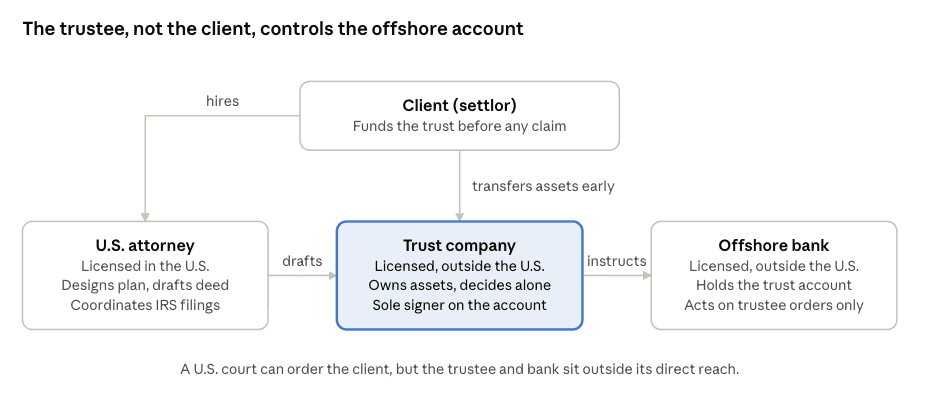
An offshore asset protection plan is not one product from one provider. It typically rests on three independent parties: a U.S. asset protection attorney, a licensed offshore trust company, and an international bank. Each holds a different piece of the plan, and the protection depends on each supporting the others.
This article explains what each party does, how they work together, and what happens when a lawsuit arrives.
At a glance
The client funds the trust and hires the attorney, but once the trust is funded, only the trust company can instruct the bank on when to make distributions. In many cases, the client can still direct how the money is invested.
The asset protection attorney
The U.S. attorney designs the plan and is usually the client’s first call. Asset Protection Attorneys such as Blake Harris and his team at Blake Harris Law handle this part of the work:
- Timing. The attorney confirms that no claim is pending or expected before anything is funded. A transfer made after a claim arises can be challenged as a voidable transfer (often called a fraudulent transfer) and may be voided.
- Design and drafting. The attorney drafts the trust deed and any LLC the trust will own, and chooses the jurisdiction and trustee with the client.
- U.S. law and reporting. The attorney may coordinate with the client’s accountant so the trust is reported to the IRS each year on Forms 3520 and 3520-A, the FBAR and Form 8938.
The attorney does not hold or invest the client’s money. That separation matters later.
The trust company
The trustee is the legal owner of the trust’s assets and the party a U.S. court cannot directly command. It must be licensed in its own jurisdiction and independent of the client.
Atlas Trust Company is a licensed offshore trustee in the Cook Islands, led by Co-Founder and CEO Marcos Almeida. Mr. Almeida is a lawyer and a STEP Trust and Estate Practitioner (TEP), and previously led the legal and client services team at another Cook Islands trust company. Atlas establishes and administers Cook Islands trusts and LLCs.
The trust company’s role typically includes:
- Running its own due diligence on the client: identity, source of funds, and pending claims
- Holding the trust’s assets, often through an LLC the trust owns
- Deciding on distributions under the trust deed, with no obligation to follow the client’s instructions, however, requests are generally honored
- Supplying the annual accounts the U.S. accountant needs for the client’s returns
Disclosure: Blake Harris co-founded Atlas Trust Company and holds a beneficial interest in it through his own Cook Islands trust. Clients of Blake Harris Law are allowed to use other licensed trustees.
The offshore bank
The bank holds the cash and investments, in an account titled to the trust or its LLC. Keeping assets with a bank outside the United States means a U.S. court order is not directly binding on the institution holding them.
Caye International Bank is an offshore bank headquartered in Ambergris Caye, Belize, and holds a Class A international banking license from the Central Bank of Belize, granted in 2003. Its president is Dr. Luigi Wewege, who has led the bank since 2021. Caye offers demand, savings and term deposit accounts in multiple currencies, and it is registered with the IRS under FATCA.
In an asset protection plan, the bank typically:
- Opens the account in the name of the trust or its LLC, with the trustee or LLC manager as the authorized signer
- Runs its own compliance review of the trust, the trustee and the client
- Takes instructions from the trustee, not from the client
- Reports U.S.-connected accounts to the IRS under FATCA
How they work together when a lawsuit arrives
The structure is tested when a creditor wins a U.S. judgment and attempts to collect on the judgment. A well-run plan typically responds in this order:
- The client calls the attorney. The attorney assesses the claim and informs the trust company.
- The trustee decides on its own. It reviews any request against the trust deed and its duties under Cook Islands law. A request made under a U.S. court order or under duress is one the trustee must refuse.
- The bank follows the trustee. The bank acts on the trustee’s instructions, not the client’s, and is not directly bound by a U.S. court order.
- The client complies with every court order. The client provides information and cooperates with the court, but no longer controls the assets and cannot direct their return.
A creditor who wants to pursue the assets typically has to start over in the Cook Islands, under its own rules and deadlines. That added cost and uncertainty often moves a case toward settlement.
What the structure can’t do
No attorney, trustee or bank can:
- Protect assets moved after a claim exists. Late transfers can be challenged and voided.
- Protect a client who keeps control or defies a court. Courts have held settlors in contempt when they did either.
- Cut U.S. taxes. The trust’s income stays on the client’s U.S. return.
- Keep anything secret from the IRS. The trust, the LLC and the bank account are reported every year.
The plan is designed so that three independent parties each do their part, and none of them answers to the client alone. If you are considering an offshore trust, the time to start is before any claim appears.
Blake Harris, Esq., is the Managing Attorney of Blake Harris Law in Miami. He is a member of the Florida Bar (#86486) and the Colorado Bar (#45942), and the author of Don’t Let a Lawsuit Take Away Everything.


