

Profitable digital businesses receive a fraction of the attention directed toward frontier AI, even though many offer current cash flow, moderate acquisition prices and limited financial debt.
A remarkably small group of technology giants now dominates the investment conversation: OpenAI, Anthropic, SpaceX, Nvidia.
Artificial intelligence, data centres and the infrastructure required to support them offer extraordinary growth potential. Their absolute revenue numbers can dwarf those of conventional private businesses. However, they also require immense and continuing capital expenditure, often while producing substantial operating losses.
Not every infrastructure commitment is conventional bank debt. Capital requirements may be funded through equity, supplier arrangements, cloud-computing commitments or other financing structures. Nevertheless, these obligations ultimately represent claims that future revenue, additional capital or financing must support.
Against this enormous AI narrative sits a far less visible market: profitable, privately owned digital businesses valued between approximately $1 million and $5 million. The reason this research excluded assets below the $1M valuation is to retain operational scale – the likes of which most non-institutional investors require before calling it attractive and passive.
These are not speculative concepts. They are functioning SaaS companies, ecommerce brands, online agencies, membership platforms and media businesses with customers, revenue and claimed operating profits.
Valuation report: The new BrokerAccord research into business valuation multiples is insightful because it measures this overlooked market according to the cash flow the businesses currently produce—not only the growth their owners hope to achieve.
A major awareness gap
Investor-attitude research I conducted through Caye International Bank, subsequently incorporated into the BrokerAccord report, found a striking difference in investor awareness.
Approximately 70% of high-net-worth investors were aware of opportunities connected with artificial intelligence and related data-centre infrastructure. Only 5% were aware of opportunities to acquire smaller profitable SaaS and ecommerce businesses in the $1 million–$5 million range.
That is a 65-percentage-point awareness gap. Put differently, HNWIs were 14 times more likely to recognize the AI-infrastructure opportunity than the market for profitable digital-business acquisitions.
Awareness does not establish value. A widely recognized investment can still produce excellent returns, while an overlooked asset can still be a poor acquisition. However, such an extreme awareness imbalance deserves attention.
It suggests that investors may be concentrating on the most visible area of technological growth while overlooking established businesses already converting technology into operating income.
The real economy is much larger than the technology headlines
It would be inaccurate to claim that SMEs produce 80% of US GDP. The verified figures still make the underlying point powerfully.
According to the US Small Business Administration’s Office of Advocacy, small businesses represent 99.9% of American firms, employ 45.9% of private-sector workers and account for 43.5% of GDP.
Small businesses are not a peripheral part of the American economy. They are almost the entire population of businesses and produce close to half its economic activity.
Yet investment coverage remains disproportionately focused on a tiny group of technology leaders, unicorns and frontier-AI companies. Their size makes them newsworthy, but size alone does not make them suitable for every investor.
There is a difference between investing in the growth of a technological revolution and acquiring a smaller business that already produces cash flow. Both may deserve consideration, but they should not be valued or underwritten in the same way.
What BrokerAccord found
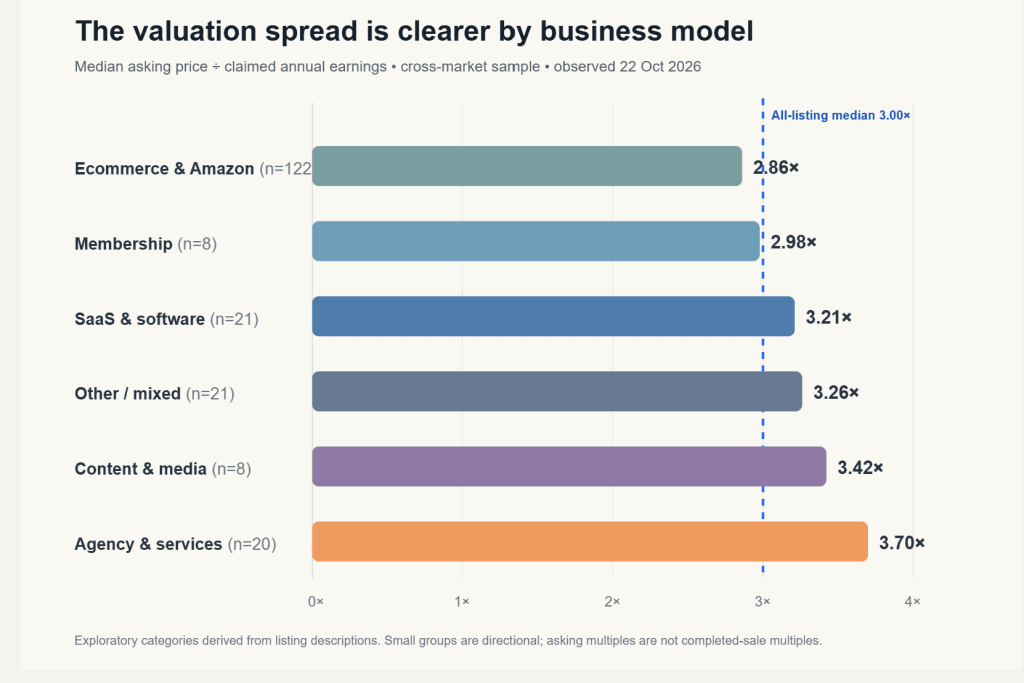
BrokerAccord examined 200 profitable businesses offered for acquisition and separated them by operating model.
Across the complete sample, the median asking price was approximately three times claimed annual earnings. BrokerAccord expresses this relationship through Acquisition Earnings Coverage: the amount of claimed annual operating earnings supporting each dollar of asking value.
At the sample median, every dollar of asking value was supported by approximately 33 cents of claimed annual earnings.
The research also showed why “digital business” should never be treated as a single valuation category:
- Ecommerce and Amazon businesses carried a median asking multiple of 2.86 times annual earnings.
- SaaS and software businesses reached 3.21 times.
- Agencies and service businesses had a median of 3.70 times.
- Content, membership and mixed businesses occupied different positions according to their economics and risks.
A SaaS company with recurring revenue, low churn and proprietary software should not be compared casually with an inventory-intensive online store. An ecommerce brand dependent on one marketplace should not be valued like a diversified direct-to-consumer business. An agency with transferable management and contracted revenue is different from one whose customers depend on its founder.
The BrokerAccord research is therefore not an argument for buying any business described as digital. It is evidence that profitable digital companies form a diverse and measurable acquisition market—one that receives remarkably little attention from HNWIs.
The debt distinction requires precision
Smaller digital-business acquisitions are frequently structured on a cash-free, debt-free basis. Financial debt may be settled by the seller or deducted when the transaction moves from enterprise value to the equity price.
That is materially different from investing in a capital-intensive frontier-AI company whose growth may depend on repeated funding and enormous infrastructure commitments.
However, “cash-free, debt-free” does not mean “free of liabilities” or “free of capital requirements.”
A buyer must still investigate leases, tax obligations, deferred payments, customer refunds, inventory, working capital, platform exposure and any borrowing secured personally by the owner. The asking-price listings used in the BrokerAccord research do not independently prove that every company has no debt.
The defensible distinction is that many smaller digital acquisitions can be purchased without assuming substantial financial debt and can be underwritten against current operating earnings. Frontier AI is generally underwritten against extraordinary future scale while requiring continued capital formation.
The latter may ultimately produce far greater absolute growth. It also exposes investors to a very different financial equation.
AI can help investors manage these acquisitions
A lack of technical expertise has historically discouraged some HNWIs from considering smaller digital businesses.
AI is beginning to reduce that barrier. It can support financial analysis, customer-service monitoring, inventory planning, marketing attribution, cybersecurity workflows and management reporting. It can give a non-technical owner better visibility into a company’s daily performance and help identify exceptions requiring human attention.
But AI does not make a weak acquisition safe. It cannot guarantee customer retention, prevent an algorithm change, eliminate platform dependency or replace capable management. It improves the owner’s tools; it does not remove the owner’s responsibility.
Overlooked does not mean low risk
A profitable digital business may offer substantially greater current earnings relative to its acquisition price than a low-yield property. That potential return exists because the investor accepts greater operational and concentration risk.
A digital business can lose customers quickly. Search traffic may disappear. Advertising costs may rise. Software can become obsolete. A marketplace account may be suspended. Revenue may depend on one founder, supplier, platform or customer group. There may be little tangible collateral if the business fails.
Real estate is not risk-free. Investors face leverage, interest rates, taxation, illiquidity, local oversupply and geographic concentration. Recent investor attitudes illustrate how easily confidence can become detached from valuation reality.
Our research found that only 40% of American investors currently consider US real estate safer than stocks, while 70% question whether property valuations can be sustained. Australia supplies a useful warning: investors there were more confident in 2025 that valuations would hold, yet combined capital-city dwelling prices subsequently fell for six consecutive months and stood 6.4% below their March 2026 peak by September, according to NAB.
The Australian example is not the central investment thesis. It demonstrates a broader principle: familiarity and confidence do not guarantee valuation safety.
Balance matters more than fashionable conviction
The appropriate response is not to abandon property or public equities and move indiscriminately into digital acquisitions. Nor is it to reject AI because its leading companies require extraordinary amounts of capital.
The appropriate response is diversification.
A balanced portfolio can combine defensive assets, liquid securities, property and carefully selected private businesses. Geographic diversification is equally important. An investor whose property, businesses, banking relationships and income are concentrated in one jurisdiction remains exposed to its interest rates, currency, regulation and economic cycle.
Diversification should also exist within a digital-business allocation. Owning several ecommerce companies is not meaningful diversification if every company depends on the same marketplace, advertising platform or national customer base.
The BrokerAccord findings should encourage investors to widen their field of view. The market for profitable $1 million–$5 million digital businesses deserves greater recognition because it offers something largely absent from the frontier-AI narrative: the ability to evaluate an acquisition using present operating earnings.
That does not make these businesses safer. It makes them measurable in a different way.
We must be clear about risk: whilst there are more opportunities to experience a greater yield in profitable digital businesses, it will always have higher risk than a low yield real estate investment. Diversification and risk appetite is something to consider carefully.
This article is general market commentary and does not constitute investment, legal or tax advice. The suitability of any acquisition or asset allocation depends on the investor’s circumstances, objectives and capacity for loss.